Welcome to our website! Call Us: +86-18622194621 E-mail:
toptac@fancyco.com

Views: 0 Author: Site Editor Publish Time: 2026-11-13 Origin: Site
Asiatic cotton mallow, commonly associated with Abutilon indicum, is a plant in the Malvaceae family known for its naturally occurring stem fibers. These fibers have traditionally been used for rope-making and other basic textile applications. More recently, researchers have studied their cellulose content and potential for use in natural-fiber composite materials.
As industries explore alternative plant-derived materials, Asiatic cotton mallow raises an interesting question: could its fibers be suitable for cigarette filter production?
This article examines the characteristics of Asiatic cotton mallow, its potential relevance to filtration materials, and how it differs from the cellulose acetate commonly used in commercial cigarette filter rods.
Table of Contents

Asiatic cotton mallow, botanically known as Abutilon indicum, is a flowering plant belonging to the mallow family, Malvaceae.
It grows in tropical and subtropical regions, including parts of Asia, and is recognized by its soft, heart-shaped leaves, yellow flowers, and fibrous stems.
The plant has traditionally been used for herbal preparations and natural fiber extraction.
Its stems contain bast fibers, which are obtained from the fibrous tissues surrounding the stem.
These fibers have several notable characteristics:
Plant-derived cellulose: A renewable fibrous material.
Natural fiber structure: Fibers can be separated from the stems through retting and mechanical processing.
Potential for chemical modification: Fiber properties can change through appropriate treatment.
Existing traditional applications: Natural cordage, ropes, and other fibrous products.
Research on Abutilon indicum fibers has explored their chemical composition, thermal stability, and possible applications in composite materials.
For additional botanical information, see the Plant Resources of South-East Asia reference on Abutilon.
Natural fibers have attracted research attention because they contain cellulose, an important structural component of many plant-based materials.
Cellulose can be processed into different industrial materials, although its properties depend on the plant source, extraction method, chemical treatment, and manufacturing conditions.
The stems of Asiatic cotton mallow contain cellulose along with lignin, hemicellulose, and other plant constituents.
A 2024 study on Abutilon indicum fibers reported changes in cellulose composition and thermal characteristics following alkaline treatment.
The findings suggest that fiber processing can substantially influence material properties.
However, results obtained from composite-material research cannot automatically establish suitability for cigarette filter applications.
Plant fibers can undergo chemical and physical treatments to modify their surface properties or separate cellulose from other constituents.
These treatments may improve certain characteristics needed for specific industrial applications.
For filtration research, additional evaluation would be necessary to understand fiber diameter, porosity, cleanliness, chemical stability, and processing behavior.
Many industries are investigating plant-based fibers as alternatives to conventional materials.
However, renewable origin alone does not guarantee biodegradability, environmental superiority, or suitability for a particular application.
Processing requirements, additives, product performance, and disposal conditions must also be considered.
Asiatic cotton mallow contains natural cellulose fibers, but there is currently insufficient evidence to establish it as a commercially proven cigarette filter material.
Its potential would need to be investigated through material characterization, filter manufacturing trials, and appropriate safety assessments.
A cigarette filter rod requires controlled fiber distribution and internal structure.
The arrangement of fibers affects airflow resistance, particulate retention, dimensional stability, and the uniformity of the finished component.
Natural Asiatic cotton mallow fibers would need to be processed into a sufficiently consistent form before they could be evaluated for such applications.
Commercial filter rod manufacturing relies on controlled raw-material properties and repeatable processing.
A new fiber source would require testing to determine whether it could be processed using existing equipment or whether substantial modifications would be necessary.
Relevant factors would include fiber preparation, moisture control, forming behavior, bonding, and finished rod consistency.
A botanical material intended for incorporation into a cigarette filter would require careful evaluation of its chemical constituents.
Heating and smoke exposure may introduce additional considerations that cannot be addressed through ordinary textile or composite-material testing alone.
No assumption should be made that a plant-derived filter would make smoking safer or reduce tobacco-related health risks.
Although Asiatic cotton mallow contains natural cellulose, it differs significantly from the processed cellulose acetate used in many commercial cigarette filters.
Property |
Asiatic Cotton Mallow Fiber |
Cellulose Acetate |
|---|---|---|
Material Origin |
Natural plant stem fiber |
Chemically modified cellulose |
Primary Composition |
Cellulose with other plant constituents |
Cellulose acetate polymer |
Established Uses |
Cordage and natural-fiber research |
Commercial cigarette filter manufacturing |
Fiber Uniformity |
Depends on extraction and treatment |
Can be controlled through industrial processing |
Cigarette Filter Application |
Requires further research and validation |
Established commercial use |
Manufacturing Readiness |
Not established for commercial cigarette filters |
Established filter rod production technology |
The main difference is manufacturing maturity.
While Asiatic cotton mallow fibers have potential interest as a plant-based material, cellulose acetate has an established role in commercial cigarette filter production.
Scientific research on cellulose acetate filters also examines their chemical, physical, and environmental characteristics.
Read more in this research on cellulose acetate materials from cigarette filters.
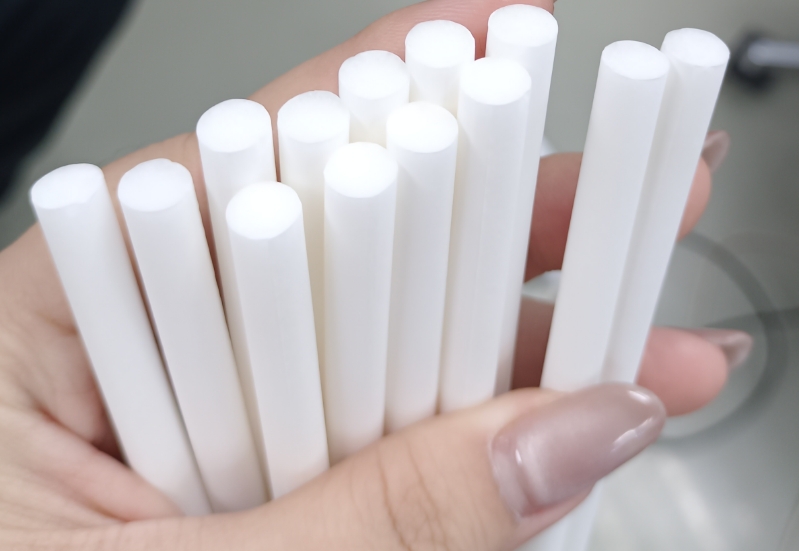
Commercial cigarette filter rods are manufactured using materials selected for their processing behavior, dimensional consistency, and specified filtration characteristics.
Cellulose acetate is widely used in conventional cigarette filter rods.
It is produced through chemical modification of cellulose and can be formed into fine fibers suitable for filter manufacturing.
Cellulose acetate tow is an established raw material for producing filter rods with controlled physical properties.
Some cigarette filter designs incorporate activated carbon into a cellulose acetate structure.
Activated carbon can adsorb certain smoke constituents under specific conditions, although actual performance depends on the filter design and test conditions.
Such designs require additional manufacturing controls to maintain consistent construction.
Other polymer materials, including polypropylene and polylactic acid (PLA), may be evaluated for particular filter development requirements.
Their suitability depends on processing characteristics, application requirements, and relevant testing.
Unlike established commercial filter materials, Asiatic cotton mallow remains a subject for potential materials research rather than a confirmed substitute.
Before considering Asiatic cotton mallow fibers for cigarette filter manufacturing, researchers would need to address several technical questions.
A reliable process would be needed to extract fibers while controlling impurities, moisture, and natural material variation.
Researchers would need to measure fiber dimensions, cellulose composition, tensile characteristics, and chemical stability.
Laboratory trials would be required to determine whether the fibers could form a consistent filter structure with acceptable mechanical properties and airflow resistance.
Testing would need to address filtration behavior, manufacturing compatibility, chemical emissions, and applicable safety and regulatory requirements.
Only after these evaluations could the material's commercial feasibility be assessed.
TOPTAC supplies materials and components for cigarette manufacturing, including conventional cigarette filter rods and related production materials.
Its current filter rod portfolio is based primarily on cellulose acetate and includes several structural configurations.
Available product options include:
Mono filter rods
Hollow filter rods
Acetate-carbon filter rods
Recess filter rods
King size filter rods
The product range supports different diameter, length, hardness, and structural requirements for industrial manufacturing.
Buyers evaluating established cigarette filter materials can explore the TOPTAC Filter Rod for Cigarette product page for available configurations and specifications.
TOPTAC also supplies related filter-manufacturing materials, including acetate tow, triacetin, and plug wrapping paper.
These materials can be found in its Cigarette Paper Filters Materials category.
At present, TOPTAC does not identify Asiatic cotton mallow as a material used in its listed commercial filter rods.
Asiatic cotton mallow is commonly associated with Abutilon indicum, a flowering plant belonging to the Malvaceae family. It is also known as Indian mallow.
The plant has traditionally been used for herbal preparations and fiber products such as ropes and cordage. Researchers have also investigated its stem fibers for potential composite-material applications.
Yes. Asiatic cotton mallow stem fibers contain cellulose along with other natural plant constituents, including hemicellulose and lignin. Their composition can change depending on extraction and chemical treatment.
There is insufficient evidence to confirm it as a commercially viable replacement. Further processing research, filtration testing, manufacturing trials, and safety assessments would be required.
As a natural plant fiber, its untreated cellulose-rich components can undergo biological degradation under suitable conditions. However, degradation behavior depends on processing, chemical treatment, environmental conditions, and the final product structure.
Cellulose acetate is one of the most widely used materials. It provides an established processing route for producing fibrous filter structures with controlled physical characteristics.
Asiatic cotton mallow is a natural cellulose-containing plant with documented traditional fiber applications and emerging materials research interest.
Although its fiber characteristics may justify further scientific investigation, there is not yet sufficient evidence to establish it as a commercial cigarette filter material.
For manufacturers requiring established filter rod solutions, cellulose acetate remains an important material in conventional production.
TOPTAC provides cigarette filter rods and related manufacturing materials, including cellulose acetate-based products in multiple structural configurations. Its existing product portfolio offers a reference for understanding the material and manufacturing requirements involved in commercial filter production.


