Welcome to our website! Call Us: +86-18622194621 E-mail: toptac@fancyco.com

Views: 0 Author: Site Editor Publish Time: 2025-08-25 Origin: Site
Nicotine pouches are not safe for kids. They are not safe for people who do not use nicotine. They are not good for quitting smoking.
Nicotine pouches can make you addicted. They can hurt your heart. They can cause mouth problems like sore gums and white spots.
These pouches do not have tobacco leaf. They give nicotine slowly through your mouth. You do not need to smoke or spit.
Young people and pregnant women have more risks. Nicotine can hurt brain growth and development.
Nicotine pouches are not shown to be safe for quitting smoking. Doctors say you should use approved therapies instead.
Many countries have rules for nicotine pouches to keep kids safe. We do not know the long-term health effects yet.
Nicotine pouches are tiny, white packets. You put them between your gum and lip. You do not chew or swallow these pouches. The pouch stays in your mouth and gives you nicotine slowly. Many people use oral nicotine pouches for a smokeless way to get nicotine. These products do not have tobacco leaf. You will not get the same chemicals as cigarettes or chewing tobacco.
You might want to know what is inside nicotine pouches. Most brands use safe, food-grade stuff. Here is what you can find in a pouch:
Nicotine comes from tobacco leaves. Makers clean it to a high level.
Plant-based fibers make the pouch and help release nicotine.
Flavorings are added. These can be natural or artificial, like fruit extracts or oils.
Artificial sweeteners, like Acesulfame potassium (Ace-K), make it sweet without sugar.
Stabilizers, such as gum arabic and hydroxypropyl cellulose, keep the pouch firm and smooth.
pH balancers, like sodium carbonate and sodium bicarbonate, help your body take in nicotine.
Humectants, such as glycerol and water, keep the pouch moist.
Note: Most ingredients in flavored nicotine pouches are okay for food use. Scientists say these pouches have fewer bad chemicals than regular smokeless tobacco. But research on long-term safety is still happening.
Nicotine pouches are different from other nicotine products. You do not need to spit when you use them. Dipping tobacco needs spitting. The pouch is white because it does not have tobacco leaf. You get nicotine through your mouth lining, not your lungs. This means nicotine goes into your body slower than with cigarettes or vaping.
Product Type | Contains Tobacco Leaf | Requires Spitting | Nicotine Delivery Speed | Flavors Available |
|---|---|---|---|---|
Nicotine pouches | No | No | Slow, steady | Many |
Dipping tobacco | Yes | Yes | Fast | Few |
Cigarettes | Yes | No | Very fast | Few |
Nicotine gum/lozenge | No | No | Slow | Some |
Oral nicotine pouches may be easier to use than gum or lozenges. You do not need to chew or move them around in your mouth. Many people like the different strengths and flavors. Flavored nicotine pouches are popular with adults.
Some people think nicotine pouches are safer than smoking. But they can still hurt your health. You can get addicted to nicotine. Addiction makes quitting very hard. Your heart and blood vessels can be affected fast. After using a pouch, your heart rate can go up. Your blood pressure can rise in just a few minutes. This happens because nicotine affects your nerves. Over time, your heart can get stressed.
Nicotine pouches can also hurt your mouth. You might get sore gums or mouth sores. White patches can show up where you put the pouch. Some people have gum recession or tooth problems. Scientists found that using pouches often can change mouth cells. These changes can cause bigger problems if you keep using them.
Nicotine can also weaken your immune system. It can make it harder to fight sickness. High nicotine levels can make you get sick more often. If you are pregnant or a teen, nicotine can hurt brain growth. It can cause learning or behavior problems. Babies exposed to nicotine before birth can be born smaller and have health issues.
Here is a table that shows how different places handle nicotine pouch safety:
Regulatory Agency / Region | Safety Warnings or Guidelines Issued |
|---|---|
U.S. Food and Drug Administration (FDA) | Needs approval before sale, health warnings, child-proof packaging, and rules for ads to protect kids. |
European Union (TPD) | Limits nicotine amount, bans bad additives, needs big health warnings, and stops flavors for kids. |
United Kingdom (MHRA) | Needs product testing, ad rules to avoid kids, and product notices. |
Australia (TGA) | Only sold with a prescription, strict safety rules, and careful checks. |
India | Bans nicotine pouches because of health worries. |
Note: Even with these rules, you should know about health risks.
When you use nicotine pouches, you may feel some effects fast. These short-term effects can be:
Sore gums
Mouth sores or white spots
Upset stomach or feeling sick
Faster heartbeat or “heart flutters”
You can feel these symptoms in five minutes. High nicotine can make your heart beat much faster. Some people feel dizzy or get a “head rush.” If you use pouches a lot, you may have more stomach pain or mouth problems.
If you feel sick or get mouth sores, stop using the pouch and talk to a doctor.
Scientists do not know all the long-term effects yet. Early studies show regular use can change your mouth. You might get white spots, dry mouth, or gum blisters. Some pouches have more nicotine than the label says. This can raise the risk of poisoning or other problems.
Nicotine can hurt the tissues that hold your teeth. It can also cause swelling in your mouth. Over time, this can lead to gum disease or losing teeth. Some pouches have small amounts of bad chemicals. These include formaldehyde or chromium. The long-term effects are still unknown.
If you are young, pregnant, or want kids, you face extra risks. Nicotine can hurt brain growth in teens and unborn babies. It can affect memory, attention, and behavior. For pregnant women, nicotine can reach the baby and cause low birth weight or sudden infant death syndrome.
Scientists need more research to know if nicotine pouches are safe. There are still many things we do not know about long-term use. You should be careful and talk to a doctor if you worry about health risks.

You may want to know how nicotine pouches compare to smoking or vaping. When you smoke, you breathe in nicotine and many bad chemicals from burning tobacco. These chemicals can cause cancer, heart disease, and lung problems. Nicotine pouches do not have these burning chemicals. You get nicotine through your mouth, not your lungs.
Here is a table that shows the differences:
Aspect | Nicotine Pouches | Smoking Cigarettes |
|---|---|---|
Nicotine delivery | Absorbed in your mouth | Inhaled into your lungs |
Main harmful agents | Nicotine only | Nicotine plus toxic smoke |
Heart effects | Raises heart rate | Raises heart rate and damages blood vessels |
Cancer risk | Not shown to cause cancer | High cancer risk |
Local effects | Mouth irritation | Not common |
Overall risk | Lower than smoking | Very high |
Nicotine pouches can still make your heart beat faster and bother your mouth. Studies show your heart and blood vessels can feel stress after using a pouch. But people who switch from smoking to pouches often have better heart health. Both products can cause addiction. Vaping sends nicotine to your brain faster than pouches. This can make vaping more addictive for some people. Both vaping and pouches can lead to nicotine dependence, especially if you use them a lot or start young.
Tip: If you want to quit nicotine, talk to your doctor about safe ways to stop.
You might also want to compare nicotine pouches to smokeless tobacco like snus or chewing tobacco. Both go between your gum and lip. Smokeless tobacco has real tobacco leaves and more bad chemicals. Nicotine pouches use plant fibers and added nicotine, but no tobacco leaf.
Aspect | Nicotine Pouches | Smokeless Tobacco |
|---|---|---|
Contains tobacco leaf | No | Yes |
Nicotine content | Can be very high | High, but often less than pouches |
Harmful chemicals | Fewer, but some found | More, including cancer-causing agents |
Mouth effects | White patches, irritation | Similar mouth problems |
Cancer risk | Not clear | Higher, proven risk |
Addiction risk | High | High |
Both can cause mouth sores and gum problems. Some pouches have more nicotine than the label says, which can make addiction worse. Scientists found both can raise your risk for mouth problems and maybe cancer. Remember, research on nicotine pouches is still new. More studies are needed to know all the risks.
You might wonder if you can use nicotine pouches to help you quit smoking or vaping. Health experts do not recommend them for quitting. The FDA has not approved these products as a way to stop using tobacco or nicotine. Instead, doctors suggest using approved nicotine replacement therapies, like gum or lozenges. These products have years of research showing they are safe and work well for quitting.
Research from Australia shows that nicotine pouches have not been tested for safety or effectiveness as quitting aids. Many people think they are a healthier choice, but this does not mean they help you quit. Some young people say pouches do not replace vaping or smoking. In fact, many users keep using other tobacco products at the same time. This can make it harder to stop and may increase your risk of addiction.
Tip: If you want to quit, talk to your doctor or a counselor. They can help you find safe and proven ways to stop using nicotine.
Nicotine pouches can be especially risky for young people. Your brain keeps growing until about age 25. Nicotine can harm this growth. It can affect your memory, attention, and mood. The CDC says that using any tobacco product as a teen can cause long-term health problems.
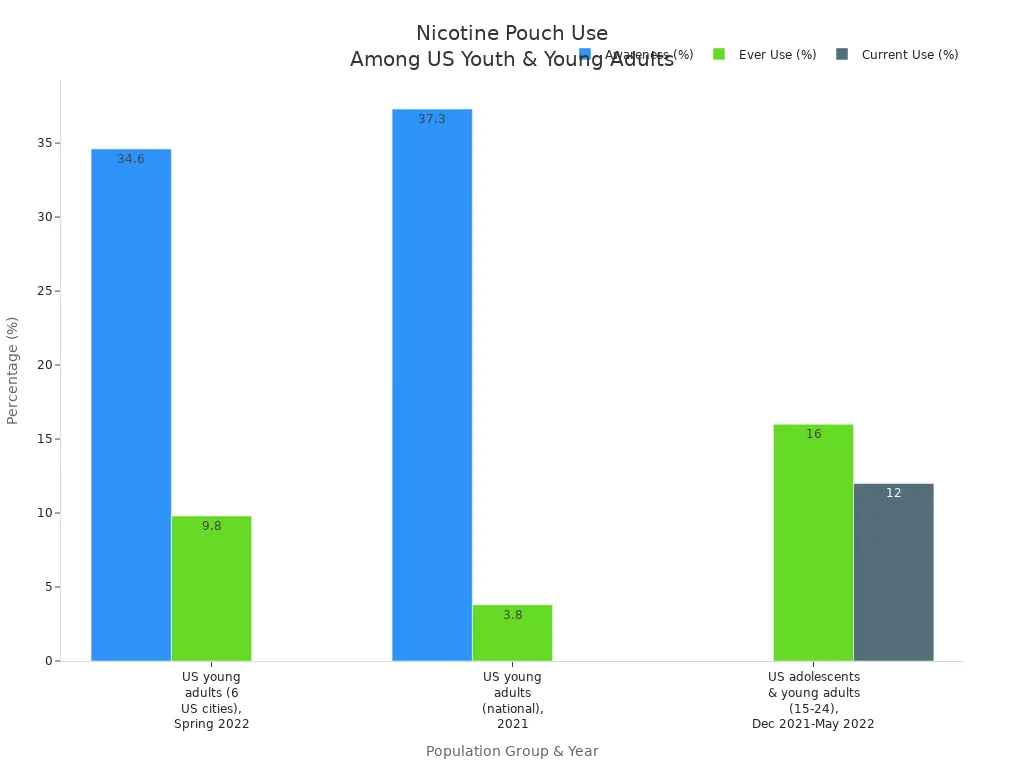
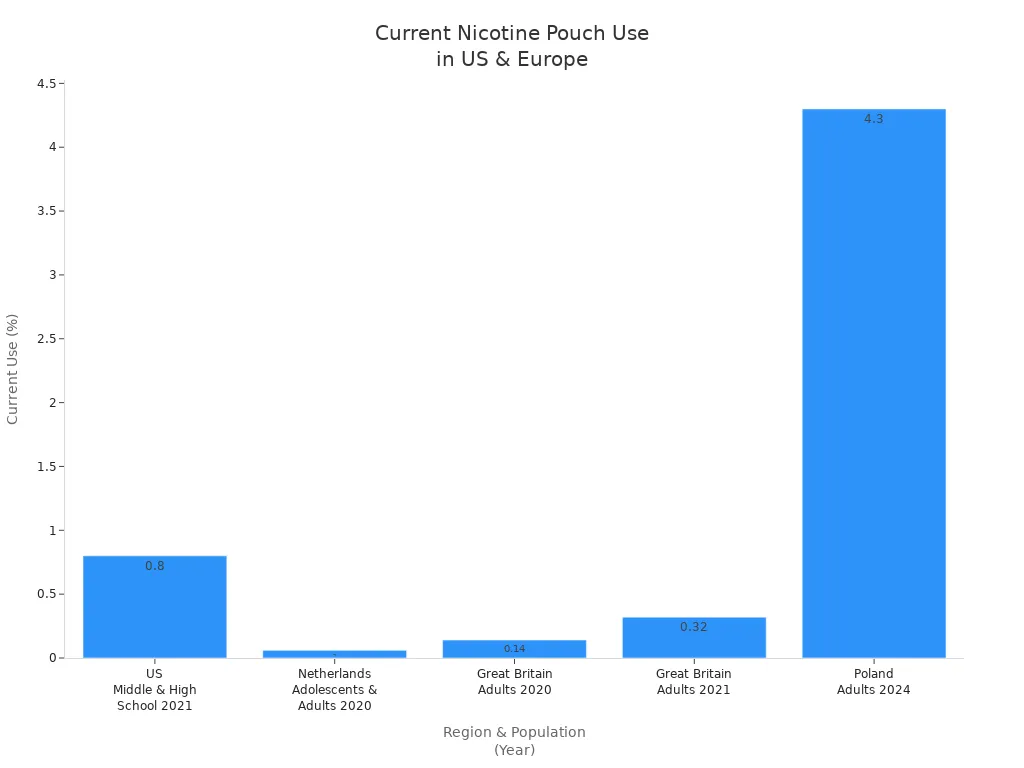
Many young people know about these products. Some try them because of flavors or ads that make them look fun. The table below shows how many youth and adults in different countries know about or use these products:
Region/Country | Population Group | Year | Awareness (%) | Ever Use (%) | Current Use (%) |
|---|---|---|---|---|---|
United States | Young adults (18–25 years) | 2021 | 41.5 | 10.3 | N/A |
United States | Middle & high school students | 2021 | 35.5 | 1.9 | 0.8 |
The Netherlands | Adolescents & adults | 2020 | 6.88 | 0.56 | 0.06 |
The Netherlands | Adolescents (13–17 years) | 2020 | 9.09 | N/A | N/A |
Great Britain | Adults | 2020 | N/A | N/A | 0.14 |
Great Britain | Adults | 2021 | N/A | N/A | 0.32 |
Poland | Adults | 2024 | 24.0 | 9.2 | 4.3 |
Public health groups warn that flavored products and ads can make more teens want to try them. Teens who use other tobacco products are more likely to try pouches too. Many countries now have rules to keep these products away from youth. Some places ban them, while others set age limits or restrict flavors.
Note: Protecting young people from nicotine is important. Learning about the risks can help you make healthy choices.
You should know that nicotine pouches are not harmless. Health experts like the CDC and Campaign for Tobacco-Free Kids warn you about risks, especially for youth and non-users. Addiction and heart problems can happen. Long-term safety is still unknown. If you want to quit, talk to a doctor or counselor. Make smart choices and protect your health.
Common Misconceptions | Facts |
|---|---|
They are safe for everyone | They can cause addiction and health problems |
Only smokers use them | Many young people try them because of flavors |
Do not swallow a nicotine pouch. Swallowing one can make you feel sick. You might get a stomachache or throw up. If you feel bad after swallowing, call a doctor or poison control fast.
Yes, you can get addicted to them. Nicotine is very addictive. If you use pouches a lot, your body will want more. It can be hard to quit once you start.
Nicotine pouches do not have smoke or tar. You do not breathe in burning chemicals. But you can still get addicted or have heart and mouth problems.
No, do not use nicotine pouches if you are pregnant. Nicotine can hurt your baby’s brain and body. Babies exposed to nicotine can be born too small or have health problems.
Nicotine pouches usually do not stain teeth like tobacco. Some people still get gum pain or white spots. Brushing your teeth helps keep your mouth healthy.


